Skip to content

It’s snow joke

This is getting ridiculous.......

For those of my colleagues who were wondering why I was logged on and working from home today, the above photo should give a clue! There was another 9cm of snow overnight, and it snowed lightly on and off all day. Some of the mounds where I’m piling up the shovelled snow are now nearly as tall as I am.

Yes, I know I’ve “missed a bit”! My arms were like jelly by the time I’d got this far, and I had to take a breather.

The tallest Mohican in the car-park

I cleared the drive daily over the weekend. Friday was by far the hardest – thereafter the additional snowfalls were little more than an inch per day (and a bit less last night) so it was much easier to shovel it off the drive. Still unaccustomed exercise though! The roads were clear enough this morning (though still quite icy) that I decided it was worth trying to get into work. Plus I was running out of fresh food, and wanted to do a shop before I was reduced to eating the emergency tins of soup in the larder.

I had cleared the worst of the snow off the car yesterday, but it was doing a very good impression of an icicle once again this morning. I have a new mandatory process for de-icing the car after the near-disaster last month: keep the driver’s door open and my house keys in my coat pocket at all times! I’m not going to risk being locked out again! However, I’m simply not tall enough to be able to clear all the snow off the roof of the car, so it looked like it had a white Mohican hair-cut down the middle of the roof! In fact, my car’s roof had the deepest covering of snow of all the cars in the car-park at work this morning, and again at Waitrose this afternoon. I suppose that’s a disadvantage of living on the top of the hills – there definitely is a micro-climate up here, with harsher weather than down in the valley.

Digging out the car

Well, it snowed pretty much all day yesterday. I spent about two hours in the afternoon wielding a snow shovel, trying to clear the drive of about 4″ of snow. But more came down in the later afternoon and overnight, so I was back out again this morning, shifting a further inch. Fortunately, my neighbours were also clearing their drive this morning, and when they’d finished theirs they very kindly helped me with mine. It was much quicker with three of us working on it!

There's a car under there somewhere.....

I must have shifted literally several cubic metres of snow. Much of it is piled up against the garage doors (on the left in the picture above) so there is no way I’ll be able to put the car away until it’s all thawed. At least it was good exercise!

The roads seem fairly clear today. While I was clearing the drive yesterday I saw a couple of snowploughs go past on the main road – or rather, they were just tractors with snowplough attachments on the front, but they seemed to do the job well enough.  I had my newspaper delivered on time this morning, but there’s been no sign of any post. I’m not planning on going anywhere until Monday, then I’ll see if I can get into work. Black ice is the next problem though, if there’s a partial thaw and a re-freeze.

Snowed in

The weather warnings have been pretty specific – expect heavy snow all day today. Since I live right up on the hills, it was very likely that I’d get snowed in. It’s not just the steep main road which is the problem. I also have a rather steep section of my drive to get off the main road, which is really tricky in the snow. So even if the main road is passable, I still have trouble getting onto and off my drive.

So yesterday lunchtime I thought it would be prudent to nip to the local shops to make sure I had enough food in for a few days. I hadn’t really taken note that a “convenience store” had opened just outside the pedestrian entrance to work – I always drive in so rarely go past that entrance. But it proved very helpful yesterday. They’d had a run of customers stocking up, as I was (I’m not going to say “panic buying”!) so there wasn’t a whole lot of choice. But I managed to get some milk, eggs, onions and tomatoes and yoghurt. I have a bread maker, plenty of pasta and some veg in the larder, and a packet of mince in the freezer, so that should be enough to keep me going for a few days until I can get to a shop.

I woke up this morning, and was glad I’d made preparations and arranged to work from home today. There is over 3″ of snow already, and it’s still coming down. The main road hasn’t been ploughed, and the only vehicles going past are tractors, 4x4s, and the occasional lorry – all very slowly. It’s eerily quiet in fact. I’ll go out later with my snow shovel and clear the worst of the snow off the drive – not because I’m going anywhere in a hurry, but because the deeper it gets, the harder it is to clear it away. It’s physically easier to clear half the depth twice, than to wait until it’s stopped and try to clear all the snow in one go.

My biggest concern is the central heating. There is a distinct design flaw with the installation of the condensing boiler. The condensate is drained via a pipe into the guttering outside the kitchen and thence into the drains. But if the gutter gets blocked with snow and ice, the water in the pipe can’t drain away and freezes in situ, and the central heating then locks out. We first discovered this problem when Chris was first ill, three years ago. He had to go up a ladder with my hairdryer to unfreeze the pipe, so that we could get the heating restarted. Subsequently, we had the drainage pipe cut off short of the guttering to reduce chances of it getting blocked. But the snow was so deep this morning that I was rather concerned the problem would reoccur. So I got out the step ladder and cleared the snow out of the gutter outside the kitchen. I’ll have to keep an eye on it, as I really don’t want to be without heating, and with the roads this bad there’s no way a heating engineer would get here easily!

Back to earth with a bump

Well, that holiday was certainly something of an adventure! It’s been a real shock to be back home (it was snowing earlier today in contrast to the 30 degree heat of Peru), back at work (bidding again), and discussing the state of my porch roof with the builder (we’ve agreed to wait until the next rainstorm and reassess its watertightness or otherwise). Plus it’s Christopher’s birthday today, so all in all I’m a bit down. I bought myself a big bunch of red tulips yesterday to help cheer me up, and they’re on the dining room table looking very bright and spring-like.

Thank you to the several people who have contacted me to tell me that the BBC is about to start a series on Lost Kingdoms of South America – Mondays 9pm BBC4. I watch very little TV, so may well have missed it otherwise, but I’ll make sure I watch the series! It looks like they will be going to Chan Chan, so I’ll be particularly interested to see if my guide’s description of the archaeology and the Chimu civilisation fits in with what the programme says.

I thought that some of the sites that I went to were off the beaten track – especially Pampa Grande on Christmas Day. But some of the places in the TV series apparently require a four-day trek through rainforest to reach, or involve abseiling down cliffs! I completely draw the line at that! Fording an unexpectedly deep river is about as off-piste as I’m prepared to go!

A final temple in central Lima

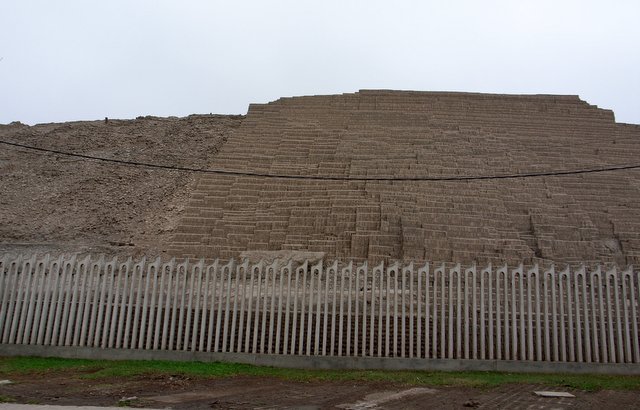
General view of Huaca Huallamarca

The city of Lima was founded by the Spanish on the site of an existing Inca and pre-Inca settlement, and some mud-brick ruins remain, somewhat incongruously squeezed in between residential buildings in the suburbs of Miraflores and San Isidro. Knowing I was interested in such things, my driver had taken me past one of the temple platforms on my way to the airport on Christmas Eve. And on the morning of my final day in Peru I was taken to the other main site, Huaca Huallamarca, which was only a 10 minute drive from my hotel.

My guide hadn’t been there recently (it’s not on the main tourist itinerary) and hadn’t checked the opening times. So we got there too early and had to wait 20 minutes or so before the gates were unlocked and we were let in. I took the photo above from outside the fence while we were waiting. You can clearly see the difference between the unexcavated part of the temple platform to the left, and the excavated and restored part on the right. Until 1945, this wasn’t even recognised as an archaeological site – the locals thought it was just a natural mound. Then the suburb of San Isidro was being developed, and a road was built right through the hill – at which point, rather too late, it was recognised as a pre-Inca site, dating from the 3rd century AD right through to the 15th century.

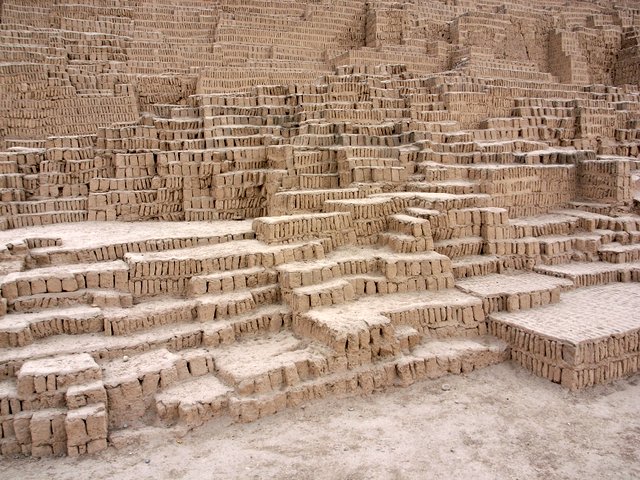
A close-up of the mud-brick construction

What I found particularly interesting was the way it was possible to get a clear view of the “bookshelf” style of assembly of the millions of mud-bricks. Apparently, this was an anti-seismic measure – in the event of an earthquake (which happens all too often in Peru), the spaces between the mud-bricks offer some flexibility to the structure, allowing it to absorb the vibrations rather than collapsing. It really made me realise just how much work must have gone into constructing the pyramids in the first place…..

The pyramid of the sun

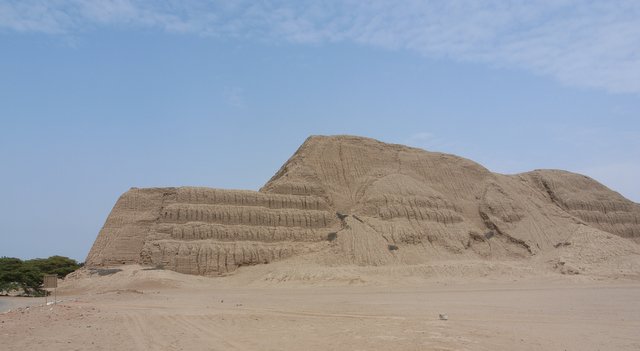
Huaca del Sol

The Temple of the Moon was on one side of a valley. On the valley floor were the remains of houses of the original inhabitants, and on the other side was the Temple of the Sun. Despite its name, given to it by the Spanish, it’s probably not a temple at all but more likely a political and administrative centre for the Moche city – like a city hall I suppose. And there is no evidence that the sun was particularly worshipped there. It’s the biggest adobe pyramid in the Americas, with over 140 million mud bricks used for its construction. Each family in the Moche empire would have to produce a certain number of mud-bricks each year as a tax or tithe, and that’s how they were able to amass the building materials for such massive structures. It’s not been excavated very much, but has been looted almost continuously since the Conquistadors first found it – in 1602 the Spanish even diverted the river to wash away much of the structure in search of buried gold!

It’s difficult to get the scale of the structure from the photo – as usual, there was hardly anyone else at the site so I couldn’t get a person in shot to give a sense of scale. According to the guide book I bought at the rather good little souvenir shop, the adobe pyramid would originally have been 345m long, 160m wide and 30m high.

There was a poster up in the ticket office, showing the number and nationality of visitors to the site. Since I visited right at the end of 2012 the figures were nearly a year out of date, but I still found them very interesting. In 2011, a grand total of 1500 British tourists visited Huaca del Sol and Huaca de la Luna – that’s about 4 per day. We were the sixth most populous group, behind the Peruvians (way out in front) with over 100,000 visitors, then the USA, Germany, France, and “other”. In total though, the site only got an average of 330 visitors per day in all of 2011 – ridiculously small (in my opinion) for such an impressive set of ruins. There was probably fewer than a dozen visitors in the whole complex when I was there.

The pyramid of the moon

General view of Huaca de la Luna (foreground) with the sacred mountain in the background

On my last day in Trujillo, I was taken to a magnificent site called Huaca de la Luna, or Pyramid of the Moon. This is a site built by the Moche people, so dates from the first to eighth centuries AD. The mountain was apparently sacred to them, so they built a temple right at the base of it. The spectacular thing about this temple is the astonishing preservation of the decoration.

Frieze of the God Aiapaec at Hauca de la Luna

One of the reasons that the paintings were so well preserved is that the Moche had a tendency to rebuild their temples every few generations, by enclosing the previous one in a newer, bigger temple platform that completely surrounded it. So some of the bigger “pyramids” might contain as many as seven concentric temples, one inside the other, a bit like Russian dolls. And of course, the outermost temple layer would bear the brunt of the centuries of erosion, whilst largely protecting the inner ones.

The main wall of Huaca de la Luna

This stunningly decorated wall is at the rear of the main ceremonial courtyard, forming the main wall of the temple platform. This was apparently the place where prisoners were sacrificed to the gods. The lower levels of decoration are very similar to the ones I saw a few days earlier at the temple of the Lady of Cao, except better preserved. It’s a bit difficult to see the details of the decorations in the picture above, so I’ve done some close-ups of the main bits.

Moche warriors, defeated in ritual combat, and now prisoners with a rope around their neck, being led off to be sacrificed

The victorious warriors, carrying the weapons and clothes of the ones they defeated in ritual combat

A row of priests holding hands as they watch the sacrifices

The stuff of nightmares! A double-headed spider god with a human head (on the left) and a human arm holding a knife

An overnight stop in Trujillo

After visiting Chan Chan, I was taken to my hotel in Trujillo. It was a very comfortable hotel, just one block from the main square. I was shattered after a long day, and just wanted to collapse on my bed for an hour or so before dinner. But there was some renovation work going on – I’m not sure whether it was in the hotel itself, or the building next door. I was on the top floor, and the hammering sounded as though it was coming from immediately above my bathroom – it was completely unbearable. I went back down to Reception with my suitcase to try to get my room changed to one that was quieter. Unfortunately the receptionist didn’t speak any English, so I had to resort to acting to get my point across. I think that “Bang Bang BANG!!!” is universally accepted language for something that’s far too noisy! Anyway, I was moved to a very pleasant room on a lower floor, further away from the din.

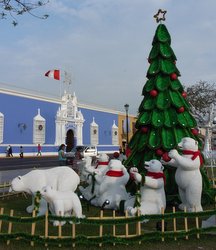
The cathedral and main square in Trujillo

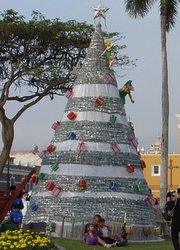
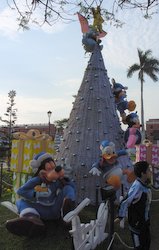
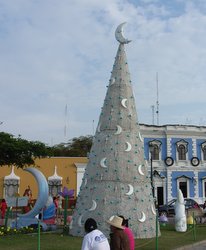
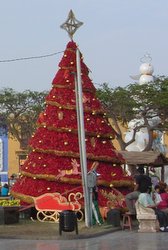
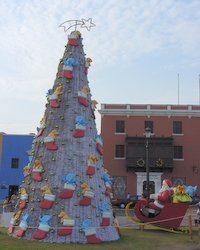
In the early evening, I went for a walk to the very pleasant main square in the city. It was founded by the Spanish, and the buildings on the main square all date from colonial times, and are very brightly painted. The square was full of families out for an evening stroll. To make things even more interesting, the square seemed to be hosting a competition for the tackiest Christmas tree. I’m sure that can’t really be what it was about – but some of them were very tacky indeed! Here is a selection of the worst……

Chan Chan – a city of mudbricks

Adobe walls in the city of Chan Chan

Chan Chan is huge – an adobe city over 20km^2, made up of ten “palace complexes”, of which only one is open to the public. The site is so big that the Pan-American highway cuts through the middle of it, and as we drove along I could see adobe walls on both sides of the road for as far as the eye could see. It was the capital of the Chimú people between about AD1000-1470, when they were conquered by the Inca who in turn were vanquished by the Spanish Conquistadors. It is now a UNESCO World Heritage site, and deservedly so.

Part of a decorative frieze

It was so big that it was difficult to take pictures of. Christopher would have done a better job with his SLR and a wide-angle lens. As it is, you’ll have to make do with some snaps of some of the details that caught my eye. I rather liked these animals – possibly squirrels? – that formed a frieze along one of the walls of the palace complex.

These look like pelicans to me

These heavily stylised birds around the edge of one of the ceremonial courtyards look like pelicans to me. The rhombus-shaped decoration on the wall apparently represents fishing nets. Chan Chan is very close to the Pacific Ocean, and the sea was clearly very important to the inhabitants. On the other hand, it could just be decoration!

Detail of a frieze of a double-headed rainbow serpent at Huaca Dragon

After Chan Chan, and covered by the same entrance ticket, my guide took me to another Chimú site, the Huaca Dragon, or “Pyramid of the Dragon”. The name is misleading though – it’s a temple platform rather than a true pyramid, and it was the Spanish who identified the mythical creatures on the walls as dragons – that was a concept alien to the Chimú, who apparently considered it to be a double-headed rainbow serpent.

General view of Huaca Dragon

I’m not over-keen on the heavy restoration of the site, clearly visible in the photo above, but it does give one an idea of what the temple would originally have looked like. Imagine all that bas-relief brightly painted, and you’ll get an idea of how garish it would have once been. The metal scaffolding is there to support a temporary roof, which can be hastily erected should rain-storms be forecast. Since they were all made entirely of mud-brick, all the sites I saw were seriously threatened by erosion. According to my guide, meteorologists are predicting another El Niño event early next year, and the accompanying downpours could cause major damage to the ruins