Skip to content

The soundtrack to Christmas

Clearly, I wasn’t going to be able to escape Christmas totally this year. Since Peru is a predominantly Catholic country, at least nominally, the Peruvians were enthusiastically celebrating.  On just about every street corner in the cities there was a nativity scene, ranging in size from a foot or so cubed to fully life-sized figures.

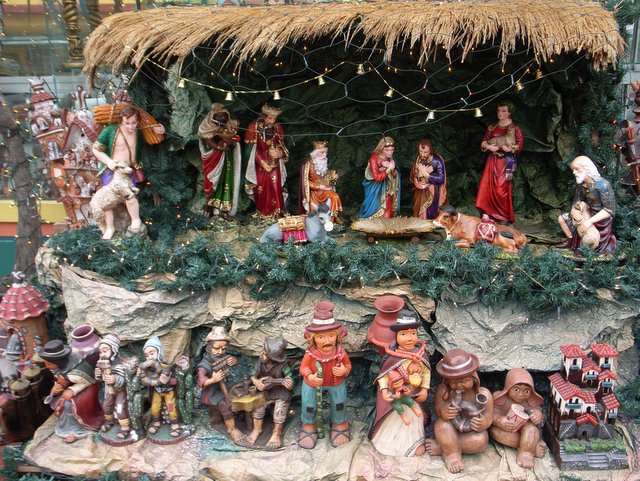
Typical nativity scene - with wise men, shepherds and indians

Above is a snap of a fairly typical crib scene, which was just opposite my hotel in Lima. I was rather tickled by the combination of Western traditions (the wise men, a shepherd carrying a lamb) and more local traditions – a cast of indigenous Andean indians playing musical instruments.

And the local instruments formed an inescapable soundtrack to my Christmas. Over breakfast I was “treated” to a compilation of Christmas classics – Rudolph the Red-nosed Reindeer, Frosty the Snowman, Jingle Bells, and the local favourite Feliz Navidad (to the tune of We Wish You a Merry Christmas) – all played on the Andean pan-pipes. Truly ghastly! I saw the CD for sale in the airport, and was briefly tempted to buy it on the grounds that no one would otherwise believe me about how dreadful it was – but I couldn’t bring myself to waste my money in such a way!

Rewriting the history books

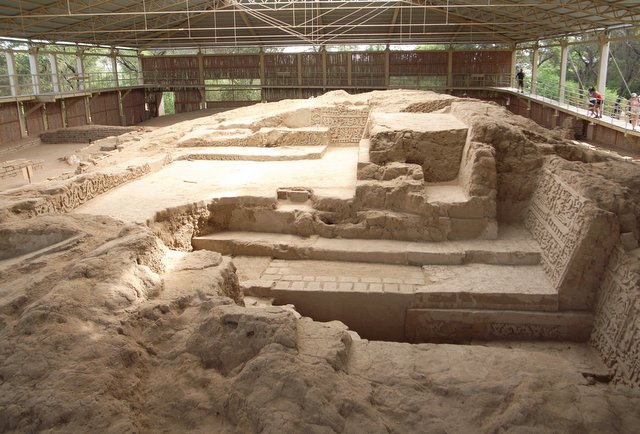
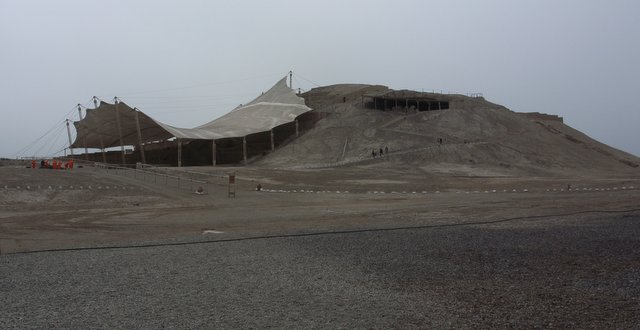
General view of the temple of Cao Viejo at El Brujo

After scattering the ashes, we drove south on the Pan-American highway for about three hours to a temple complex at El Brujo (The Witchdoctor) where some very interesting discoveries had been made in 2006 which the archaeologists are still getting to grips with.

The first part of the visit was interesting enough. You can see from the picture above that there is a sail-like protective roof over the excavated side of the temple platform. This is because the archaeologists discovered some stunning reliefs adorning the wall of the temple.

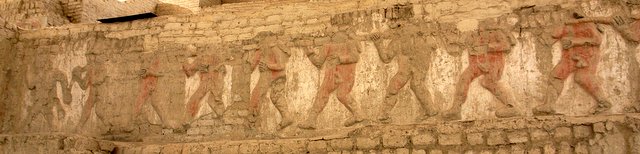
Naked prisoners, roped together and about to be ritually slaughtered

This is a frieze showing a procession of warriors who have just been defeated in ritual combat – a bit like a gladiatorial contest in Ancient Rome. They have been stripped naked, tied together with a rope around their necks, and are being marched off to be ritually slaughtered. Talk about blood-thirsty!

But, although that was very impressive, it is not unique. It is apparently the standard way that the Moche people decorated their temples, between the first and eighth centuries AD. Later in the week I saw another temple decorated in much the same way. What really surprised the archaeologists was what they discovered near the top of the temple platform, now protected by the second roof at the right in the top picture.

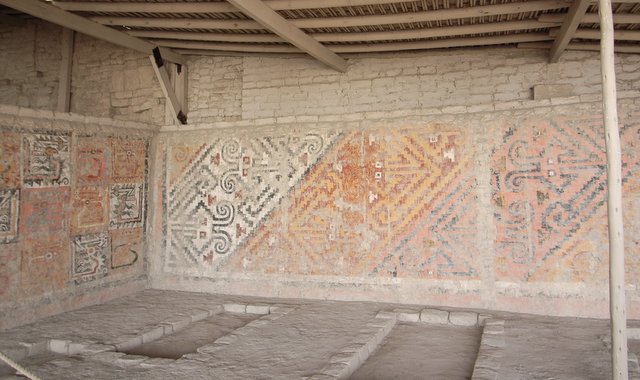
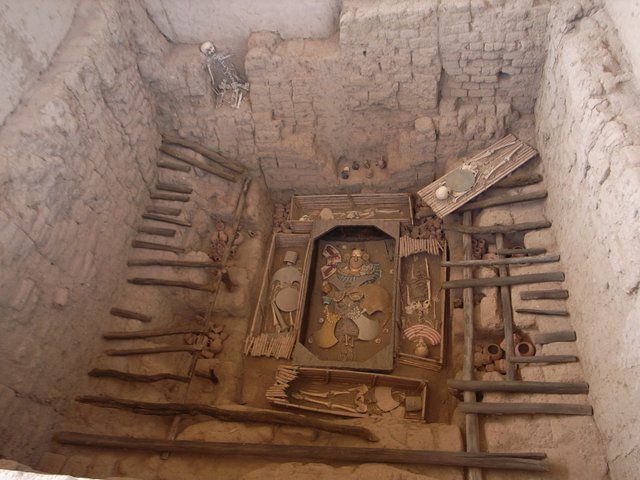
The burial chamber at the temple of Cao Viejo

This was a stunningly-decorated burial chamber with a main burial (just off the edge of the picture to the bottom left) and four subsidiary burials – three of adults (two of which you can see above) and one of a child (just visible in the bottom left corner). The date was the same as one of the earlier burials from Sipán (known as the Old Lord of Sipán), i.e about AD300. The grave goods were very comparable to those of the Old Lord too – golden nose rings, gold crowns/headdresses, necklaces of gold, silver and precious stones, and a gold-encrusted tunic. Clearly, this was the grave of the ruler of the valley of the Rio Chicama.

But there were a few anomalies that puzzled the archaeologists. For a start, all of the adults who were sacrificed to join their ruler in the afterlife were male, apparently priests and warriors – there were no wives or concubines found. The body was wrapped in many metres of finely woven cotton fabric, which the archaeologists painstakingly unwrapped. Then they got the shock of their professional lives. For inside the wrappings wasn’t a lord at all – it was the mummified body of a tiny woman (only 1.48m, 4’10” tall) aged about 20-25, who apparently died in childbirth. She has been named the Lady of Cao. Until her discovery, the (predominately male) archaeologists had always assumed that only men could rule in pre-Inca Peru. And that is despite a line in one of the chronicles written by the Spanish Conquistadors saying that this particular region of Peru was traditionally matriarchal. Now they are having to rethink their ideas and rewrite the text-books to encompass the idea that women could and did rule significant areas in pre-Inca Peru.

As we left the temple complex, my guide asked me what I felt, as a woman, about the fact that the Lady of Cao had been the ruler of the district? As a somewhat strident feminist, I had only one word in reply – “YES!!!!

Peruvian “bas cuisine”

I’m trying to think what the opposite of “haute cuisine” would be. I need my friend F. to advise, but “bas cuisine” is close enough. It’s fair to say that the food was not one of the highlights of the holiday! But then, I went there for the five-star rubble rather than fine dining, so I suppose that’s fair enough.

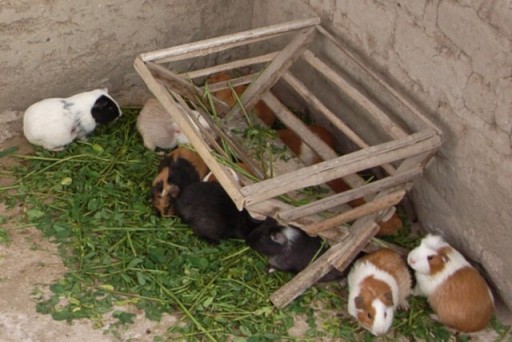
Unroasted cuy

Peruvian cuisine is meant to be very good – but I suspect that only really applies in the best restaurants in Lima (which were well beyond my budget). Peruvian restaurants are apparently the latest “new thing” internationally, and I’ve read recently about some opening in London. I guess however that the national dish in Peru wouldn’t translate well to London – it’s roast cuy. That is, roast guinea pig. Most families up in the mountains will have a couple of guinea-pigs living in the corner of their main room – but they’re not pets; they’re dinner! On the wall of Cuzco cathedral is a painting of the Last Supper, showing Christ and the disciples tucking into a roast guinea pig…. Perhaps fortunately, I wasn’t offered cuy on this visit to Peru – I really wouldn’t have fancied it for Christmas lunch!

While I was in Chiclayo and Trujillo, I was on half-board, which meant that a three-course lunch was included at a local restaurant. The restaurants were fine – clean, with a reasonable choice of dishes, but hardly a gastronomic treat. Cuy wasn’t on the menu, but goat was. In fact, I was offered it in several places – but turned it down each time. I’ve eaten goat before, and not been impressed – it was tough and gamey. If I could have been sure it was kid, I might have gone for it, but I really didn’t fancy eating a stringy old billy-goat! Instead, for Christmas Day lunch, I had stingray omelette. That was peculiar – very salty and fishy, but actually surprisingly pleasant. And it certainly made a change from roast turkey!

The other local speciality, which I felt I was honour-bound to try, was ceviche. That’s raw fish, marinated in lime juice, onions and chili, and served with maize and sweet potatoes. Afterwards my guide asked me what I thought of it. I said that it was “Interesting”, to which he replied “Hmmm, I know what that means!” I shan’t be having it again in a hurry……

One thing I did enjoy was a dessert at a restaurant in Trujillo. This wasn’t actually the place I was meant to be eating at – but when my guide and I arrived at the appointed restaurant for lunch it was clearly closed, with firemen standing outside. It had burned down early that morning! My guide was very miffed that nobody had phoned him to tell him the restaurant was closed! I thought that was a bit unreasonable of him – they probably had more pressing worries! He phoned his office in a bit of a panic to ask for advice, and was clearly told just to find another nearby restaurant for me, and buy me lunch there instead. So I ended up at what was really not much more than a café, clearly only used by locals not tourists, but which had churros on the menu. These are a bit like doughnuts – sticks of deep-fried dough, sprinkled with sugar, which you dip in hot chocolate. Yummy!

Scattering the ashes

I took some of Christopher’s ashes with me to Peru, with the aim of scattering them somewhere I thought he’d appreciate. He would have really enjoyed the holiday, and would have loved taking photos of all the ruins.

Obviously, I didn’t know the area at all, so I asked my guide for some advice for somewhere suitable to scatter the ashes. At first, he was completely flummoxed by my request – I think they go in for burial in Peru, rather than cremation, so the whole concept was alien to him. He asked what sort of place I was looking for. I replied somewhere peaceful, but that didn’t seem to help him. Even though he spoke excellent English, he asked me to type my requirements into his Blackberry so that he could translate them to be sure. Then he said “Yes, I did understand you the first time! Let me think about it”

The next day, the day after Boxing Day, we drove south from Chiclayo to Trujillo, stopping off at a number of archaeological sites on the way. When he and the driver met me at the hotel at 07:30 that morning, the guide said that he’d been thinking overnight, and had come up with a couple of options to discuss with me. One of them I thought was particularly appropriate, so I went ahead with it.

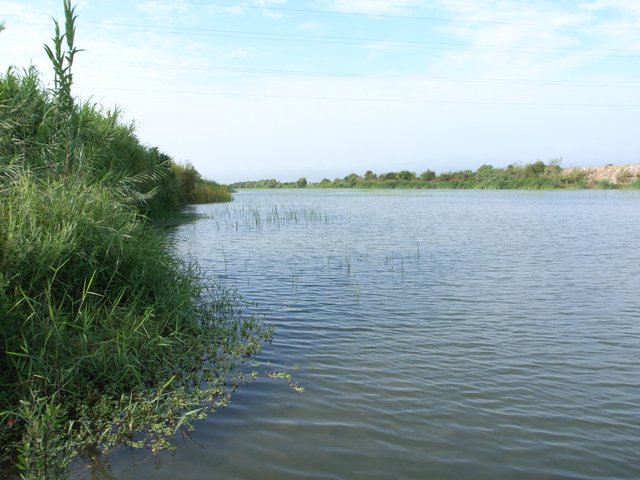
The River Reque where I scattered some of Christopher's ashes

This is the Rio Reque, a few km south of the city of Chiclayo.  This is the same river, but further downstream, as the one we only just managed to ford on Christmas Day. The tomb of the Lord of Sipán and Pampa Grande are upstream on one side of the river, and the Pomac Forest is on the other side. So I’d spent the last two days exploring 1500 years of ancient civilisations in the valley of the Rio Reque, as well as nearly getting swept down it myself!

The guide found a surprisingly tranquil spot, with sugar-cane fields on either side, and I scattered a small jar of Christopher’s ashes into the river. I think that he would have approved.

Boxing Day – the Valley of the Pyramids

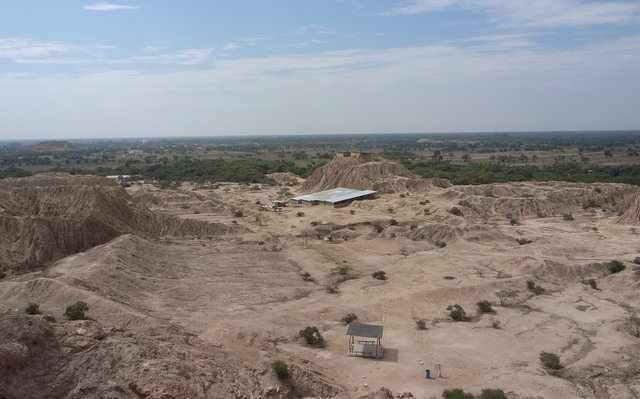
A general view of the Valley of the Pyramids

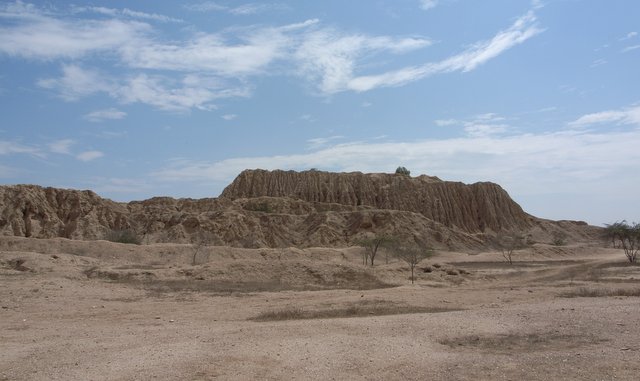
On the afternoon of Boxing Day, my guide and driver took me to Túcume, also known as the Valley of the Pyramids. In fact, they’re not really pyramids at all, but large mud-brick platforms, some used for ritual purposes (e.g. temples) and others apparently being administrative complexes. It’s mostly unexcavated as yet, but there have been some small-scale digs and you can see in the picture above some temporary shelters, designed to protect the exposed archaeology from the elements – being mud brick, it’s all very easily eroded. We walked up to a vantage point and once you got your eye in it was possible to see man-made platforms all over the valley floor. There are about 26 of them, covering an area of over 500 acres, and dating from AD800 to the Spanish conquest in AD1532.

Two of the mud-brick "pyramids" at Túcume

Although there hasn’t been much excavation to date, some very interesting structures have been uncovered, which give a feeling for how the temples would originally have looked.

An adobe temple, showing some original bas-relief decoration

To the left of centre, you can see a ceremonial square. The walls are covered with bas-relief decoration – it looked mostly like highly stylised birds, fish and waves. Imagine those brightly painted in red, yellow, blue, black and white – and then replicate that across the valley floor – it would have been very gaudy indeed to our eyes.

This site was slightly busier than Pampa Grande the previous day, in that I wasn’t the sole visitor there. But there were only a very few tourists, mostly Peruvian, wandering around. It felt a real priviledge to have such a glorious site almost entirely to myself!

The back-up team

Some of my friends seem to think I’m a pretty intrepid traveller, given the way I keep taking myself off to interesting places for holidays. In fact, it’s hard work travelling long-haul by myself, especially to somewhere where I don’t speak the language. There’s nobody to keep an eye on my bags while I nip to the loo, nobody to share the excitement with, and perhaps worst of all, nobody to have dinner with – I do hate eating in restaurants on my own. I miss Christopher dreadfully when I’m travelling, but I don’t intend to give up holidays just because my domestic circumstances have changed.

I may be moderately well-travelled, but I’m not prepared to travel outside Europe completely by myself. I feel much more confident if I know that I’ve got a back-up team doing all the hard work with the logistics and generally looking out for me. Which is why I decided to put myself in the hands of a company with a decent reputation, and ask them to make all the arrangements. Yes, it cost more to have a fully tailor-made holiday, with a guide, driver and car entirely at my disposal for the week. But it was immensely reassuring, and meant that I needn’t worry at all about getting to the sites, finding clean restaurants for lunch, or dealing with public transport in a totally unfamiliar language. (I don’t speak any Spanish at all. At school we had the choice of Spanish or German. All my close friends chose German, and a group of girls I considered to be right bitches chose Spanish. So it was an easy choice. Thirty years later, Spanish would be considerably more use to me!)

I was met at Arrivals at Lima airport, and subsequently at Chiclayo airport,  by a uniformed rep holding a card with my name on it, and whisked off to my hotel by an English-speaking driver who made sure I checked in with no problems.   On my first day in Lima I was also given a “Traveller’s Assistance” card. This was an unexpected bonus. It provided a 24/7 emergency backup telephone number, offering up to two free visits from a doctor or to a hospital,  medical transfers back to Lima in case of necessity, some limited cover for medical expenses if hospitalised and for prescriptions, and help tracing lost luggage. Obviously, it’s not a substitute for fully comprehensive travel insurance, and I fortunately didn’t need it – but it was good to know that if I’d had a minor injury such a twisted ankle falling down from a temple, help would have been at hand without having to call on the big guns of my travel insurance. That was very reassuring.

I had two guides, one in Lima and the other in Chiclayo & Trujillo. They were both good – very knowledgeable and informative, pleasant, and with excellent English. They too wore a uniform, and had done three years of training to become a licensed guide, so they really knew their stuff. In all I think I had five drivers over the week, so I didn’t get to know them as well as I did the two guides. But I felt very safe with all of them – which was no mean achievement considering the generally appalling standard of driving I witnessed on the roads every day!

So although I was indeed travelling by myself and not as part of a group, I had a whole back-up team whose job it was to look after me, do all the hard work with the arrangements and transport, and generally make sure the holiday ran smoothly. All I had to do was set my alarm to the right time to make sure I got up and was ready at the agreed pick-up time each morning. It worked very well, and I would have no hesitation in making similar arrangements again.
Boxing Day – the Lord of Sipan

On Boxing Day I was again picked up from my hotel at 08:30, and driven out to Huaca Rajada, a mud-brick burial platform from the Moche culture, spanning the years approximately AD1-700. Archaeologists were first alerted to the site in 1987, when looters discovered a burial rich in gold. There was a major falling-out amongst the thieves, and someone shopped them to the local archaeologist who turned up with armed police to raid the village and recover many of the gold artefacts.  Subsequently,  sixteen undisturbed burials have been discovered, some of them very rich indeed. The most famous one, the Lord of Sipán, dates from around AD300, and is sometimes described as “the Tutankhamun of South America”.

The tomb of the Lord of Sipán

The original gold and gilded-copper ornaments are now in a brand new museum in the town of Lambayeque (which I visited but photography was forbidden), but on site in Huaca Rajada there is a reconstruction of how the tomb was found. The Lord of Sipán is in the middle, with gold and turquoise earrings, pectoral ornaments made of shell beads, and  gilded-copper crowns, back-protectors, and standards. He apparently died a natural death, and when he was buried six people were sacrificed to accompany him to the next world. Some were women – presumed to be his wives/concubines, one a child, and another perhaps a priest. The two bodies on the level above the principal burial have been interpreted as guards – their feet were amputated so that they couldn’t run away but would have to stay and guard the lord for all eternity!

Christmas Day exploring mud-brick temples

As I mentioned yesterday, I’d challenged Explore Tailormade to come up with a full programme of visits on Christmas Day, despite the fact that it was a public holiday in Peru and all the main site were closed. They rose to the challenge magnificently. I was picked up at 8:30 in the morning by my driver and guide, and taken first to Pampa Grande, about an hour and a half outside the town of Chiclayo.

Mud-brick temple platform at Pampa Grande

Between about AD600-800 this was a dense urban settlement, around four square kilometers in size, and was home to tens of thousands of people. But it’s completely deserted these days, and isn’t on the regular tourist itinerary. On Christmas Day there were just three of us there – me, my guide, and my driver. My guide said that in the six years he’d been working as a guide in and around Chiclayo, he’d only ever taken four other tourists to visit the site! But as you can see from the photo above, there were some spectacular ruins of temple platforms made of millions of mud bricks. Apparently, this one would have been close on 40m high.

There was one clearly apparent reason for the lack of visitors. The road to get there was appalling – more potholes than asphalt. My driver was less than impressed, and was worried about his suspension, so didn’t want to go back into Chiclayo the way we had come. There was a good asphalt road on the other side of the river valley that led directly back to town, and he wanted to take that. First though, we had to find the river – which meant going along rutted farm tracks in between fields of sugar cane. Having followed our nose to the river, we then had to find a crossing. According to a teenage lad that the guide stopped to ask directions of, there was a bridge downstream.  But we couldn’t find it – though there was a ford. As we got there, we saw a motorbike-taxi coming towards us which had clearly just forded the river, so the driver decided to go for it. Well, the rainy season had just started up in the mountains, and the river was deeper and faster-flowing than he had anticipated! The water was way up above the door sills! It would have been ironic if I’d escaped the Christmas floods in Worcestershire, only to get swept downstream in Peru…… But we made it across, and after asking another seven farmers the way to the main road, finally found it.  All in all, I preferred the original route…..

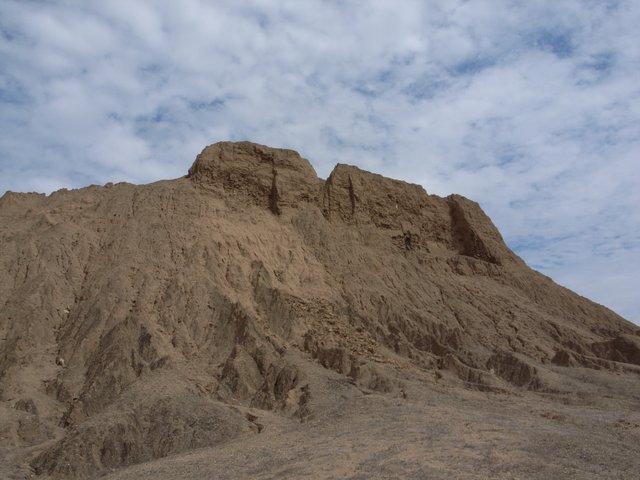
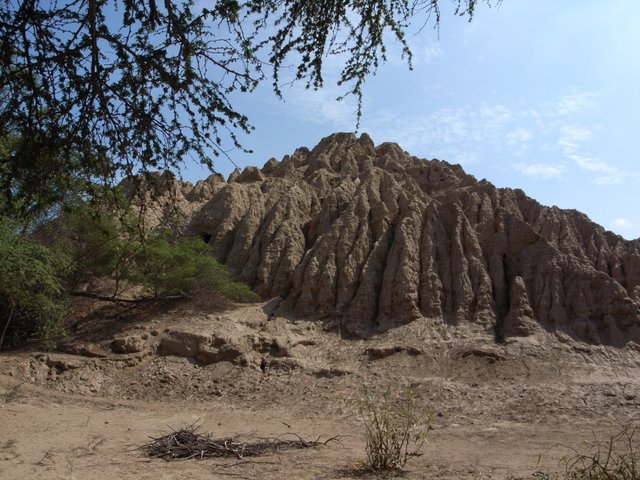
A mud-brick temple in the Pomac Forest

In the afternoon we visited another pre-Inca site, a series of mud-brick temples in the middle of a national forest reserve. We had to sign in, and I could see that I was just the fourth visitor that day – the other three were from Lima, and we soon spotted them having a Christmas Day barbecue in the back of a motorbike-taxi in the middle of a dry river bed. It did seem a bit risky having a coal-fired barbecue in the middle of a tinder-dry forest of carob trees, but one doesn’t apply European standards of Elf’n’Safety in South America! You can see one of the temple platforms in the photo above. The heavy erosion of the mud-bricks is caused by the downpours which occur during the El Niño weather phenomena. My guide told me that there was a particularly bad El Niño storm on 14th February 1998, when his neighbour’s house, which was made of adobe (mud bricks) was completely washed away! So you can imagine what centuries of storms would do to a temple platform made entirely of sun-baked mud.

Escaping Christmas

I really dislike this time of year. It’s not Christmas in itself that’s the problem, but rather the fact that it was just before Christmas in 2009 that Chris was first diagnosed, out of the blue, with cancer. We spent the entire Christmas and New Year period going from one hospital appointment to the next, getting worse news each time. Hence I strongly associate this time of year with acute misery. So rather than sitting at home on my own feeling depressed, or inflicting my moods on friends and family, I prefer to go away for Christmas and escape it completely.

Last Christmas I went to Cambodia, and that worked so well that in May I got back in touch with the same travel company that arranged it, Explore Tailormade, and asked them to start thinking about an itinerary for this Christmas. We settled on Peru, but not the standard tourist itinerary of Machu Picchu and Cuzco, because Chris and I went there for our tenth wedding anniversary, and I didn’t think I would cope too well with returning there. Instead, I asked for a fully tailor-made itinerary to the much less visited pre-Inca archaeological sites of Northern Peru – just me, not part of a group tour, but with a car, driver and English-speaking guide all to myself. I planned to pay for it using Christopher’s pension, and to take some of his ashes with me to scatter there.

It took several weeks of iterating and negotiating before I had an itinerary I was happy with, a duration that suited me and a price I could afford. I made it a very important precondition that I had a full day of site visits on Christmas Day itself – I really did not want to spend the day sitting by myself in a hotel room feeling miserable. But Peru is a very Catholic country (albeit in many ways in a thin veneer on top of continuing Inca and pre-Inca belief systems) so Christmas Day was a public holiday and almost everywhere was shut. I told Explore that I wanted a cast-iron guarantee that I wouldn’t be left to my own devices on Christmas Day, and that if they couldn’t provide it then the holiday was off. That concentrated their minds, and I think that the travel consultant I was dealing with found it quite interesting to craft a suitable itinerary. I also got her to take out all the visits to craft workshops, artisan potteries and traditional fishing villages that crept into the draft itinerary (i.e. thinly disguised retail opportunities!) to allow for more time actually looking at the archaeological sites.

I flew out to Lima via Madrid on 22nd December, spent a week in Lima, Chiclayo and Trujillo, and arrived back in the UK on Sunday. I had a good time, and was indeed kept very busy at the critical time, so all the planning paid off. I’m still so jet-lagged I don’t know what time-zone I’m in, but once I get my head straight I’ll start writing up an account of the trip, with accompanying photos.

Status check

Since it’s very nearly the end of the year, I thought it would be instructive to look back at my New Year Resolutions from a year ago, to see how things turned out.

They were, in no particular order:

  • Fixing the leak in the porch roof, which drips every time it rains – hmm. Still ongoing, and not for want of trying. It seems to get better each time the builders have another go at it, but I’m really not convinced it’s fixed.
  • Getting the kitchen decorated – yes – done in January. And patched up again in October after the chimney leaked causing a stain…..
  • Starting to plant some interesting climbers on the terraces in the garden – Work in progress. Carol and Mark have been very helpful, and I now have a gardener coming regularly to keep on top of the weeding. I can’t do much during the winter, but Carol and I will shortly be making plans for the Spring….
  • Increasing my hours at work – but in a sustainable way, so that I avoid an exhaustion-triggered collapse – No, completely failed to do this. In fact, I had a letter from HR just last week confirming that I’ve been moved onto permanent part-time working, the flexi-time equivalent of a three-day (22.5) hour week.
  • Scattering some more of Christopher’s ashes somewhere interesting – the Tiber in Rome was certainly interesting, and I have other plans as well. There are plenty of ashes left, so I shall have to keep thinking of more places to scatter them. Work in progress.
  • Keeping on blogging – yes!

So that’s two unconditional “yes”, three “ongoing work in progress”, and a “no”. A bit of a mixed bag, but I suppose there’s no real point in making resolutions that are trivial to keep.