Skip to content

Slow, slow, quick, quick, slow

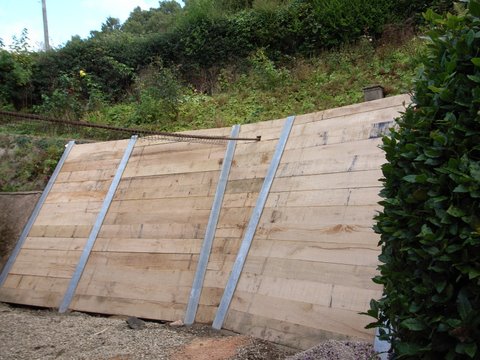
Sorry, no photos of the garden tonight – it was raining when I got home from work and I was in no mood to stand around getting wet. Besides, there wasn’t a great deal new to see.  I’m impatient to get a better view of what the terraces will look like, and am really keen for the builders to finish off laying the sleepers in the upper terrace. But they have other views on the order things should be done, and have spent the last two days doing necessary but less “showy” stuff.

The foreman, Pete,  told me yesterday that, now they’ve done all the hard work getting the levels of the bottom row of sleepers and the angles of the I-beams right, actually slotting the sleepers in place should be “a piece of cake”. So they are leaving that until later in the week, and concentrating for now on the more challenging task of getting the fencing sorted out for the lower terrace. That’s actually a pretty big job, and there is a lot of preparatory work to do in concreting posts in place, and setting the correct levels and spacings for the wood. They firmly believe in “doing the job properly” and are taking absolutely no short-cuts.  But that does mean two days of marginally-visible progress, compared to the huge leaps and bounds they did last week.

The previous “fence” was hardly worthy of that name, being some wooden batons about 1″ wide by 1/4″ deep, tacked together. The uprights weren’t even concreted in place, just sunk into the path. It was absolutely lethal – there is no way it would have broken my fall if I’d tripped, and I had to be careful not to lean on it when going up or down the slope.  The new fence is based around sturdy uprights, about 3″ square, buried deep into the path and concreted in place. Pete leaned heavily on it this afternoon to show me how strong it was, and it easily took his weight.

I have to say that I am very pleased with the builders, Hollins Landscapes. They came highly recommended by my colleague Adrian, and I can definitely endorse that.  They are a family firm – the foreman and number two are brothers – and don’t have a website, as they get virtually all their work by word-of-mouth with minimal advertising. They really do seem to know what they are doing, and are very thorough. Their mantra seems to be “if in doubt, over-engineer it” and they will not rush the job. I’ve been most impressed with their attention to detail, which you can see in the way that the sleepers all line up horizontally, even though the garden itself isn’t particularly level.

I’m hoping that, once this preparatory work has been done, visible progress will leap forward again by the weekend – when (weather permitting) I’ll post a few more pictures.

Confusing the neighbourhood cat

Next door’s cat has been spending a lot of time over the past few afternoons and evenings sitting on the path between the lower and upper terraces, looking at the steel I-beams, membrane and sleepers with what looks like a puzzled expression on its face. I think it’s bothered about where all the mice have gone, as there used to be rather a lot of wildlife living in the concrete blocks, which I’m sure the cat is used to hunting. The builders have clearly frightened the creatures away. Indeed, they found at least one empty mouse nest, snuggly lined in moss. The cat looks mystified as to where its prey has gone.

I, however, know exactly where the missing mice have gone to. Straight up the wisteria on my bedroom wall and into my loft, where they have been holding loud tap-dancing competitions between midnight and 2am daily, directly above the head of my bed! Fortunately, I’m on very good terms with Tim, the local pest controller, and have him on an annual retainer and call-out contract. He’s been once already to attempt to deal with them, and it all went quiet for a few days. However, the riotous party started again last night, and if it doesn’t go quiet by Monday I’ll need to call Tim out again to have another go. In the meantime I’m going to look out my ear-plugs……

Making good progress on shoring up the hill

A colleague asked me today how I was getting on with building the Ledbury Bypass! I can see what he means – the amount of material the garden is swallowing is absolutely massive. Ten tons of pea gravel were delivered this morning while I was having my breakfast, and it’s all been used up already today filling in the gap between the wooden sleepers and the underlying concrete blocks. And that’s just for the lower terrace.

Here’s a “record shot” showing progress to date, taken from the same vantage point as before:

Progress after three weeks

The builders have given themselves the rest of the week off, as they have a family wedding coming up. That’s fine by me – I’m paying them for the job, not by the hour, and anyway I could do with a couple of builder-free days myself. They have pretty much finished the lower terrace now, bar the fencing which will run along the top.  It’s looking pretty impressive, and it’s getting much easier to visualise what the completed project will look like.

Lower terrace behind the house

The picture above shows the lower terrace at the back and side of the house. Directly in front in the picture is a slope going up to the second terrace. To help orientate you, the previous photo was taken from the upper-left-hand corner of this picture. The most tricky bit of the build so far has been the corner to the middle-left of the photo, where the sleepers have all needed to be cut at an angle to make them fit.

Outside the kitchen door

Another tricky bit was directly outside the kitchen door, where the sleepers needed to be fitted around the oil-pipe leading to my boiler. They’ve done a very neat job there I think.

Dealing with 300 sleepers

The 300 new oak sleepers that I need for the garden have been cut to order by a saw-mill in the South of France. They were meant to arrive last week, but have been delayed. They have apparently been stuck on a lorry on the other side of the Channel, due to high winds disrupting the ferries. The 30-odd timbers that the builders used up last week were ones the dealer already happened to have in stock, but we’ve been waiting for the full amount to be delivered. I was beginning to get a bit concerned, as I had to pay for them up-front, and it’s a lot of money to have tied up on a lorry somewhere on the Continent….. But they arrived at 9am today, thankfully before the next forecast storms hit and stopped the ferries running again.

The next problem is where to store them. There is not space on my small drive for 300 sleepers – not as well as my car, two white vans, a trailer, a portaloo and several tons of sand and gravel. And I’m sure my lawn would not survive them being stored there either. However, the dealer who provided the timbers had a cunning plan. He is a local farmer, who seems to have diversified into supplying used and new sleepers, presumably as another source of income alongside farming. Handily for me, he knows many of the local farmers, who form quite a tight-knit community. Specifically, and very usefully, he knows the farmer at the bottom of the hill, less than five minutes away from me. This local farmer has agreed that, for a “small consideration”,  the sleepers can be stored in his farmyard, and he’ll bring them up on his tractor, thirty at a time.  That’s really convenient, and I’ve jumped at that suggestion as it very neatly solves the problem.

I don’t think he’ll have to store them for very long. The builders have made massive progress today, and the bottom terrace is virtually complete, apart from the fiddly bits in the corners.

Garden progress – two weeks in

The builders have been hard at work on the garden. All of the steel I-beams (all 29 of them!) have been positioned and concreted in place. Since each beam weighs about 1/3 of a ton, and it all had to be done by hand as there is no space for heavy machinery, this was a pretty labour-intensive job. They have been using a little tracked vehicle to take the beams from the drive round to the back of the house, but after that it’s all grunt power. No wonder that the number 2 builder put his back out on Monday and had to go the osteopath to get put back together again!

Here’s a picture of progress to date.

Progress after two weeks of slog

The first row of sleepers is also in situ, carefully positioned to a common level, and concreted into place. That should set firm over the weekend, meaning that next week the rest of the sleepers can simply be slid down the [-sections of the I-beams and they should all line up correctly. Well, I say “simply”, but it’s a four-man operation. Two men at the top, positioning the beam and slotting it into the I-beams, and two men at the bottom, holding it in place with long poles, then gradually lowering it so that it slides down in a controlled manner to rest in the correct place.

If you look carefully, and it’s particularly visible on the upper terrace, you can see that the I-beams aren’t actually resting on the underlying blocks, but are standing slightly away from them by a few inches. This is because the blocks don’t form a completely flat surface, but a distinctly uneven one with bulges. So if the I-beams rested flat against the blocks, it would be impossible to slide the sleepers down without them snagging on the uneven blocks. And that would mean needing to remove lots of the blocks to make a flatter surface – which we want to avoid doing.

The plan therefore is to pour “pea gravel” down the gap between the sleepers and the black membrane. I’m told that pea-gravel acts rather like sand – easy to pour, but then compacts solid. And it will also trap water, improving the drainage. So the underlying soil will be held in place first by the blocks, then by a layer of compacted gravel, then by the I-beam and sleeper combination. I think I can be confident that, once it’s all in place, the garden will be adequately stabilised and won’t be moving anywhere in a hurry!

Foundation Deposits

The combination of having a large number of deep holes in my garden, and a jar full of Christopher’s ashes was too great an opportunity to ignore. So I have deposited some of his ashes in the garden, where they have subsequently been concreted in place and become part of the foundations of the new terraces. That seems fitting – whilst I shall scatter most of his ashes on holiday, as I agreed with him, it’s only right that some should remain here in our garden.

With a bit of luck, I shall really confuse future generations of archaeologists who come to explore the British Camp hillfort. Archaeologists are notoriously quick to ascribe to “ritual” that which they don’t understand, and it might look to them like a “foundation deposit”. In archaeological terms that’s “a collection of objects buried within the walls or under the floors of a building”, believed to have been buried there as part of a ritual  to ensure the goodwill of the gods.  This was a widespread practice from at least Ancient  Mesopotamian times. There are examples from Roman London where animals, such as small dogs or a lamb, had been buried beneath floors where houses had been rebuilt after a fire. Elsewhere in Roman Britain, there are examples of human burials as foundation deposits.

I didn’t bury his ashes to secure the goodwill of any local deities, nor to bring good fortune, but simply because I think he ought to be buried somewhere he loved. But it’s very difficult to infer intent from a mere collection of objects, so I have every hope that a future archaeologist will decide that there was a deeper “ritual purpose” involved.

More useless customer service

This month’s A Mammoth Undertaking prize for insensitive customer service goes to……. cue drumroll…… BT.com

The telephone land-line was, like all our utilities, in Christopher’s name. So this time last year I spoke to BT, explained that he was dead, and got it moved into my name. So far, so good – no dramas, and all the paper bills have been correctly addressed to me since.

But at some point over the years, Chris must have signed up online to bt.com. That did not transfer over to me when I notified BT of his death, even though it is attached to the same phone number, account number and address. He (or rather, his email account) keeps getting emails from BT,  telling him that his bill is available to look at online.

This time last week, I’d finally had enough. I filled in a web-based complaint form, giving them all my details and saying “I told you a year ago that my husband Christopher Booth had died. You changed the account to my name – at least for paper bills. But you have not updated the online account. You are still sending emails addressed “Dear Christopher” and the mybt account is still in his name. This is extremely upsetting. Please change it ALL to my name.”

To give them their due, they got back to me within two days. But the reply was distinctly less than helpful – it boiled down to “I need to advise you that I cannot change the name on your on line account. Only the account holder can make these changes to their on line account.”

You can guess what that means, can’t you? Yes, I had to log in as Christopher with his username and password. The username was straightforward, but of course I didn’t have a clue about the password. Funny that. Anyone would think that as he was dead it might be difficult for me to actually ask him – but that doesn’t seem to have occurred to BT. So I had to get the password reset – which involved answering a security question which Christopher had set up. Fortunately he’d chosen one to which I knew the answer – so it wasn’t even particularly secure. If it had been something more obscure I’d not have been able to do so.

A year ago, I accepted these nuisances as just part of the general crap one has to deal with when one is bereaved. But I’m not feeling so charitable now. I think its absolutely unforgivable that major companies have such appalling procedures in place to deal with the death of one of their customers. The online stuff is the worst – they really don’t seem to have thought through the ramifications of passwords and so-called security questions when the account holder is no longer around to answer them. I at least am self-confident (some might even say bolshie) enough to make a fuss. But I feel very sorry for more vulnerable people who have to deal with all this extra aggravation at an already extremely difficult time.

Dubrovnik

My holiday already seems a long time ago. Four days back at work, including an extra-long day at our Hampshire headquarters, are quickly turning it into a distant memory.  So, before I completely forget about it, I should like to put on record one of the highlights of the trip, Dubrovnik.

BA flies from Gatwick directly to  Dubrovnik airport, which is to the south of the city. The coach from the airport to the cruise ship followed the coast road, along the top of the cliffs with some spectacular views down into the bay. I was sitting on the correct (left) side of the coach, and was rewarded with tantalising glimpses of the old city of Dubrovnik out of the coach windows.

Dubrovnik glimpsed from the coast road

We arrived at the ship around lunchtime. The old port of Dubrovnik is far too small for cruise ships, so we were moored at the commercial port, several kilometers away on the other side of the headland. Our cabins were not ready, so the crew showed us into the lounge, and gave us an iced tea and ham & cheese baguette for lunch. That was very welcome, as I was expecting to have to find my own lunch that day, since the full-board cruise didn’t officially start until dinner that evening. Most of the passengers on the ship were French, and the flights from Paris and Lyon did not arrive until the evening, so I think the crew prioritised sorting out the cabins of the English-speaking guests. I was able to access my cabin from shortly after 2pm – my suitcase had already been placed in it – and then had the rest of the afternoon free.

I decided to explore Dubrovnik by myself. In fact, I think I was the only one of the passengers to go off exploring on their own that afternoon. But it was really easy. I caught the bus number 1B from directly outside the cruise terminal, and it took me straight to one of the two main gates of the old city. It took around ten minutes, and cost 12kuna (about £1.50). I then spent the rest of the afternoon wandering around the old city, drinking in the history. It was very hot – the buildings and pavements are all made of limestone, and the sunlight and heat reflected off them so that it was almost like walking around in an oven.

One place I particularly liked, at least partly because it was cool and shaded, was the Franciscan Monastery which had the most beautiful colonnaded cloisters. My attention was caught by one particular set of columns, which had carved hands and feet sticking out from the base, as if some poor sinner had been crushed underneath!

In the cloisters of the Franciscan monastery

The next day, we were taken by coach into Dubrovnik for a guided tour. Since that would just go to the same places as I had visited the previous day, I decided to give it a miss, and instead walk the ramparts before it got too hot.  According to my guidebook “One of the most exhilarating walks anywhere in the world is to go on a complete circuit of the ramparts”. Even allowing for standard guide-book hyperbole, they clearly were not to be missed. The ramparts are nearly 2km long, date from the 15th-16thC and completely encircle the old town.  In some places they are up to 6m thick, which means they managed to survive the bombardment of 1991 remarkably intact.

Dubrovnik from the ramparts

The wall-walk took over an hour to complete, and it was again very hot – around 35°C. I was so glad I hadn’t waited until the afternoon, when it would have been even hotter. But just when I thought it was too hot and I’d have to stop for a rest, a little café would come into view, situated in one of the defensive towers. The chilled drinks may have been overpriced, but were very welcome all the same!

I really liked Dubrovnik – it was a fascinating place, if a bit too touristy for my taste. But then I was a tourist too, so I can’t really complain about that! It had been very badly damaged in the bombardment of 1991, with very many of the buildings taking direct hits. But they have done a very good job of reconstructing it, though there are still plenty of signs of shell damage if you look for them. I think it would be an ideal place to go for a long weekend (a week would be too long I think – I’d get bored), but preferably not in high summer. I would imagine it’s delightful in spring and autumn.

The garden: work in progress

As a reminder, this is what my garden looked like before work started on it. The concrete slabs are held in place solely by friction and gravity, and the so-called fence was absolutely lethal – very fragile and barely able to hold up the weight of the honeysuckle and clematis that were growing over it,

Before work started

After four days of hard manual labour by the builders, this is what it looks like today, from pretty much the same viewpoint.

progress after one week

The original concrete slabs are all still in place – we didn’t want to destabilise the slope by removing them. They are however covered up by the black sheeting, a heavy-duty water-permeable membrane. It should allow water to drain away, but stop weeds growing through it. The galvanised steel I-beams are concreted in place on the lower terrace, into holes around 1.2m deep, so they are not going to move anywhere in a hurry.  The holes are dug in the second terrace ready for the next tier of I-beams to be inserted and concreted in on Monday.

Unwanted water features

The builders turned up on time on Tuesday, and have spent the last three days digging a series of large holes in my garden, which the steel I-beams will be concreted into. They have shifted literally tons of soil, clay and rock.

In just about every hole they have dug so far, they have found something man-made that we’ve had to stop to think about. To start with, it was a yellow plastic pipe at the base of the bottom retaining wall that they thought was a land-drain, but was at too great a depth to be effective. Then at the next level up they came across a whole load of water pipes that were clearly not in use. We discussed it this morning, and came to the conclusion that the two things must be the plumbing for a rather ghastly water feature that was in the garden when we moved in.

There was a waterfall, tumbling from the first terrace over a rockery into a small pond, which was permanently overgrown with blanket-weed. The waterfall was fed from the well via an electric pump. That explained both the water pipes (and an associated tap/stopcock they found which I had forgotten about) and the so-called land drain, which seemed to be going from the region of the pond back towards the well to complete the circuit of water.  Both Chris and I disliked water features in general and this one in particular, so we had the pond dug up about a year after we moved in. The pump from the well stopped working the following winter, and we never bothered to fix it. So I told the builders that they could just carry on digging up the remnants of the pipes and land-drains, and didn’t need to re-instate them once the holes were dug.

I was more worried about the second, inadvertent water feature that became apparent this morning when they hit my water main between the meter and the house. Fortunately, they only hit it with a spade rather than with the machine-driven auger! But even so there was enough damage done to cause it to spring a leak. And this was first thing in the morning, before I’d even had my shower! Fortunately there was enough water pressure left for me to get washed, otherwise I’d have been even more unhappy about it! The first thing I checked when I got home this afternoon was that they had fixed it, as I most certainly do not want a new pond in the garden!

Minor (?) incidents like that aside, I’m pleased with the progress they are making. They are finding it very labour intensive, as most of the work needs to be done by hand. But they seem to be on schedule, and certainly appear to know what they’re doing.